


Four Paradoxes of AI Adoption in Law Firms

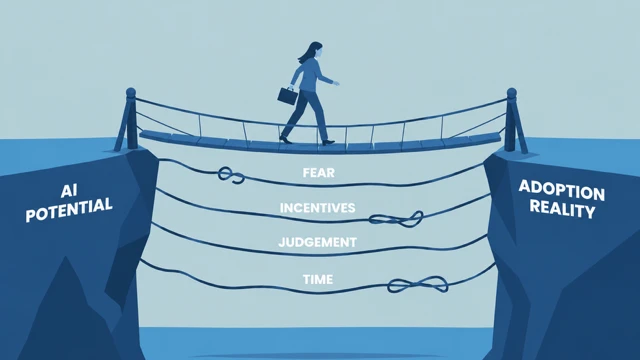
I recently ran a workshop for senior marketing and business development leaders from a group of law firms. Every firm in the room had the technology, mostly Microsoft Copilot, with some running Claude or ChatGPT alongside it. Almost everyone was using AI daily and yet nobody felt adoption was going as well as it could.
What emerged wasn’t really a technology conversation. It was four paradoxes, each of them counterintuitive and each pointing to a slightly different fix.
Paradox One: The Juniors Are the Resisters
Everyone in the room had braced for the same thing: the senior generation digging its heels in while digital-native juniors raced ahead. The opposite has happened and, in firm after firm, it’s the juniors dragging their feet.
Three reasons came to light. First, fear—and not irrational fear either. When a partner returns from a conference musing aloud that “we might not need as much marketing function because of AI,” junior staff hear it. Second, conditioning: this generation spent school and university being told that using AI is plagiarism. We are now asking them to unlearn that overnight. Third, careers are no longer linear: “Why master a tool for a role I may not want in two years?”
The research agrees: Gallup finds 48% of employed Gen Zers now say the risks of AI at work outweigh the benefits, up from 37% a year ago.
Paradox Two: Using AI Well Can Look Like Writing Your Own Redundancy Notice
One leader in the room is among the heaviest AI users in her firm. Her own team hardly touch it. It is easy to see their logic: if I visibly do this work with AI, I’m demonstrating I’m not needed; if I do it myself, I’m indispensable.
No amount of lunch-and-learns on how to use AI will overcome this resistance for as long as efficiency reads as expendability. Until people believe that AI capability makes them more valuable rather than more dispensable, staying away from the tools is a perfectly rational choice.
Paradox Three: The Leaders Feel Like Imposters, but Hold the Scarcest Asset
Most senior marketing and BD leaders built their careers on relationships, strategy and client insight, not technology. Now they’re fronting an AI agenda and privately feeling like frauds. Yet the room kept circling back to one truth: nobody is an expert in this. Not the IT team, and not the vendors or the consultants either. The questions that matter, like how AI changes client relationships, pitching, loyalty and the trusted-adviser role, aren’t technical questions at all. They’re exactly the questions these leaders are qualified to answer.
More importantly, senior people hold the one thing AI cannot supply: knowing what good looks like. One story from the workshop made the point. A senior partner received an unusually polished document, beautifully structured and confidently argued. It took her three readings to spot that the strategy underneath was fundamentally flawed. This is a common issue widely coined as “workslop”: AI output that masquerades as good work and can take significant time to rework. Judgement is the antidote, and it tends to sit with the people who feel least confident about the technology.
Paradox Four: The Time Saved Never Comes Back
A business case that took three days now takes a day and a half. A strategy deck went from three days to under one. And yet nobody in the room felt less busy. “Everyone is in fifth gear all the time,” as one director put it. Efficiency gains are being instantly absorbed by rising expectations, and the constant verification of AI output is itself tiring work. Firms that treat AI purely as a volume play risk burning out the very people driving adoption.
Ways to Approach It
Listen Before You Legislate
One idea landed hardest in the room: run a client-listening programme with your own team. Sit down, ask what’s actually holding them back, and resolve it collectively. The parallel applies to clients too. One firm’s client panel revealed that clients don’t have the answers either, and are happy to figure it out together. Stop assuming and ask.
Fix the Incentive, Not Just the Skills
Say explicitly, and mean it, that AI capability is career protection, not career risk. People who use AI well will replace people who don’t; make sure your team hears that from leadership, not just from LinkedIn.
Prove, Don’t Preach
Map your team’s recurring tasks, pick two or three use cases, test them properly, record the results. Evidence moves a partnership far more than enthusiasm does.
Make Governance Liveable
A one-page, regularly updated set of standards beats the twenty-page policy in a drawer. Include transparency: normalise saying “AI assisted with this.” It builds trust and protects quality.
Conclusion
What struck me most is that not one of these four paradoxes is really about AI. They’re about fear, incentives, confidence and time—the same things that have always decided whether change sticks. The firms that read them early and lead their people through honestly will be the ones still ahead once the novelty wears off.