How Small Law Firm Marketing Teams Can Amplify Their Impact

I spoke recently with a marketing director at a midsize law firm – someone smart, strategic, and doing the work of three people (sound familiar?). This director had a solid initiative she wanted to advance: a more consistent process for getting attorneys to share their wins and expertise across the firm’s practice areas. It was a good idea with a solid business case, and she’d been advocating for it for months.
She told me, “I keep bringing up my idea with the managing partner, but I can’t get traction.”
That’s when I asked: who else is feeling this problem in the firm?
It turned out that two practice group chairs had been frustrated about the exact same issue – for a long time. She just hadn’t thought to start there.
It’s a pattern I see often. Small law firm marketing teams have plenty of good ideas, but often spend too much energy trying to get them adopted by struggling to convince the wrong people.
Are You Talking to the Right People?
Most marketing leaders in small and midsize firms are managing without a large team, broad formal authority across departments, or a clear mandate from leadership. When something isn’t moving, their instinct is to push harder — explain it better, bring it up again, or wait for just the right moment to make the case.
But capacity doesn’t scale through exertion. Rather, it scales by getting the right people on your side. So, instead of asking “How do I get approval for this?” start asking “Whose influence could amplify this idea?”
One question puts you in a waiting position. The other places the power back in your hands.
Find the Right People to Support You
Not everyone can multiply your impact to the same degree. So you will want to calculate whose advocacy will gain you the most support.
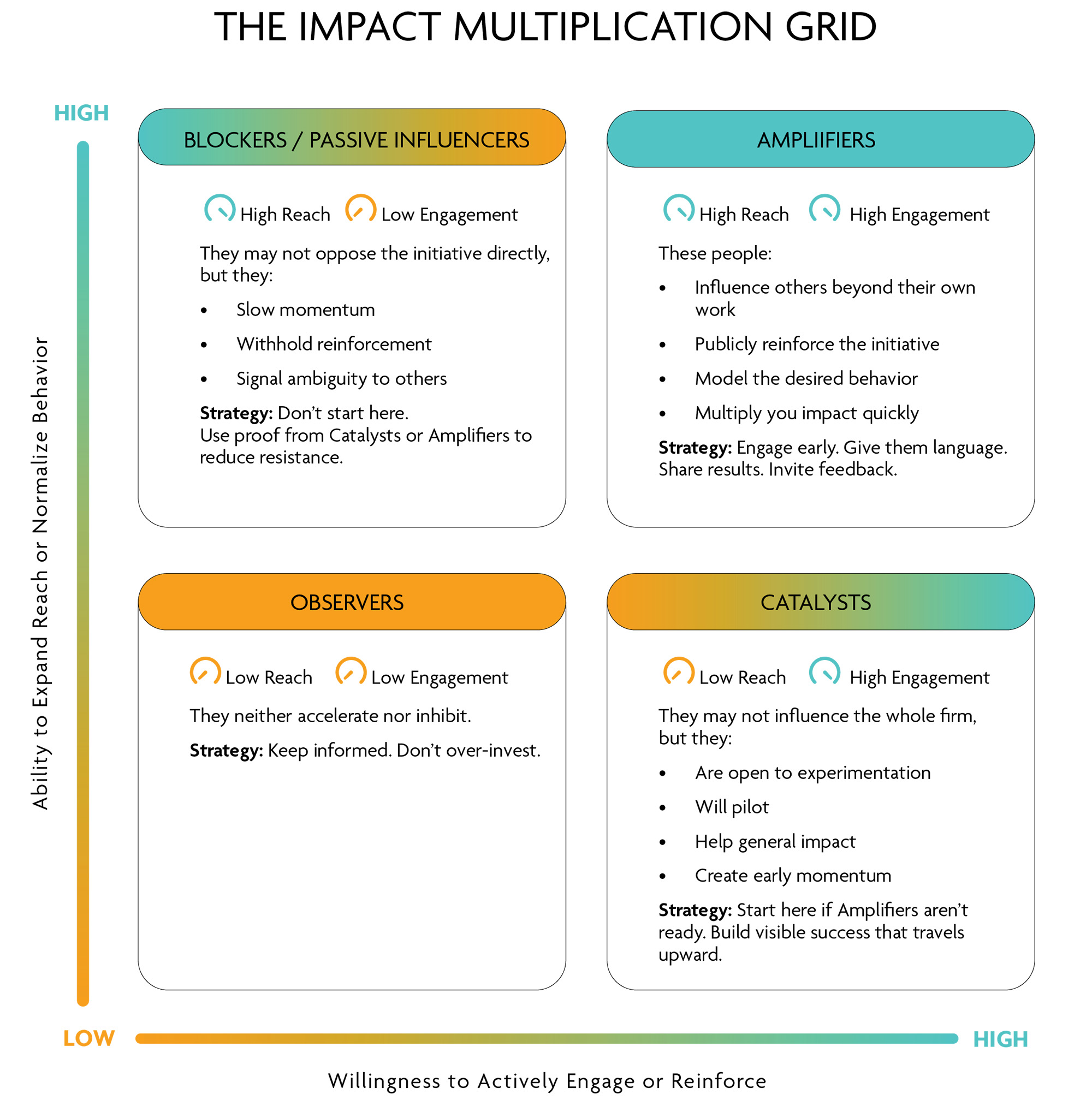
Some people have broad reach across the firm and are genuinely willing to use their influence for a cause they support. These are your Amplifiers. They can influence others around the firm, publicly reinforcing initiatives and modeling the behavior you’re trying to spread. When you find one, engage them early, sharing results and inviting their feedback. They’ll do more for your initiative than any top-down approval ever could.
However, Amplifiers usually need proof before they’ll publicly back something. So when your Amplifiers aren’t ready, try a Catalyst.
A Catalyst may not have broad organizational influence yet, but they’re open to experimentation, willing to pilot something new and ready to create early momentum. With their help, you can build something visible and let the results travel upward.
Most people spend their time trying to convince Blockers — people with broad reach who aren’t actively engaged with your ideas yet. They may not oppose your initiative directly, but they may slow your momentum, withhold support, and signal ambiguity to others. Resist the instinct to tackle them first. Instead, use proof from your Catalysts and Amplifiers to reduce their resistance over time.
One other type to be aware of is Observers. These are the people who neither accelerate nor inhibit your initiative. They’re aware of what you’re doing but aren’t invested in it one way or another, neither resisting nor reinforcing your ideas. Keep them informed, but don’t spend meaningful time or energy trying to convert them into something they’re not.
Match the Right Person to the Right Initiative
The above framework tells you who is ready and willing to move. However, the type of initiative you’re trying to advance should shape who you approach first.
If you’re trying to move something that touches revenue, risk or firm economics, the best place to start is finance. You’re not selling them on marketing, but reframing the initiative to make any financial benefits to the firm crystal clear. When finance sees it from that perspective, your initiative can gain a powerful advocate.
If you need behavior change, such as attorneys showing up differently or participating more consistently, a practice group leader is often your best entry point. You don’t need the whole firm to support your initiative, just one group or practice chair who’s feeling the problem. Pilot it there, then let the results – and that chair’s enthusiasm – speak for you.
Don’t Look For One Champion To Save You
Avoid the fragile strategy of relying on a single sponsor. If that person changes roles, loses interest, or gets pulled into other priorities, your initiative may stall. A more resilient model looks like this: a practice leader pilots, and an informal influencer normalizes it in conversation. Now the initiative has roots in multiple places, and it doesn’t depend on you being in every room.
That sort of impact multiplication results in the moments when leaders start referencing your initiatives without prompting, when you’re invited into conversations earlier, and when others, unprompted, start connecting ideas back to your marketing strategy.
This kind of shared ownership is well within your reach — even if your team is small.